
Most sites do not need a private cellular network. The ones that do usually know something is wrong long before they know what to buy — and then the wrong solution is provided for a project because three different products are marketed together.
This is the qualification piece. It is as much about the no as the yes, because a private network integrated into a site that did not need one is a bad outcome for everybody, and a slow one to recover from.
Three questions that settle it
What has to leave the site? Not “do you need internet”. What specifically has to get out, at what quality, and for how long at a stretch. Six camera feeds is a different problem from a hundred handhelds checking email, and different again from a telemetry stream that must not fail.
What happens if the data does not arrive? This is the real qualifier. If the answer is that somebody refreshes and it comes back, the public network is probably fine. If the answer is that a broadcast drops, a crane stops, or a client is watching, then you are buying certainty rather than bandwidth — and certainty is a different product.
Who else is on the air? A venue holding 145,000+ consumer phones, as at the Kentucky Derby, is not the same radio environment as an empty field. Contention is the failure mode that surprises people, because the link tested fine at 9am.
When you do not need one
Often, and it is worth saying plainly.
A permanent site with fiber already in it and an intricate Wi-Fi DAS that holds up does not need a private cellular network layered over the top. A small crew in a venue with good public coverage and no contention problem is usually fine on the public networks. When the requirement is coverage indoors rather than control, neutral host infrastructure is frequently the right answer and a cheaper one. When the requirement is resilience on a modest feed, a bonded uplink across several carriers does that job — we build them routinely as backhaul off our own networks.
Those are real answers and we give them. The argument for a private network has never been that everything else is broken.
When you do
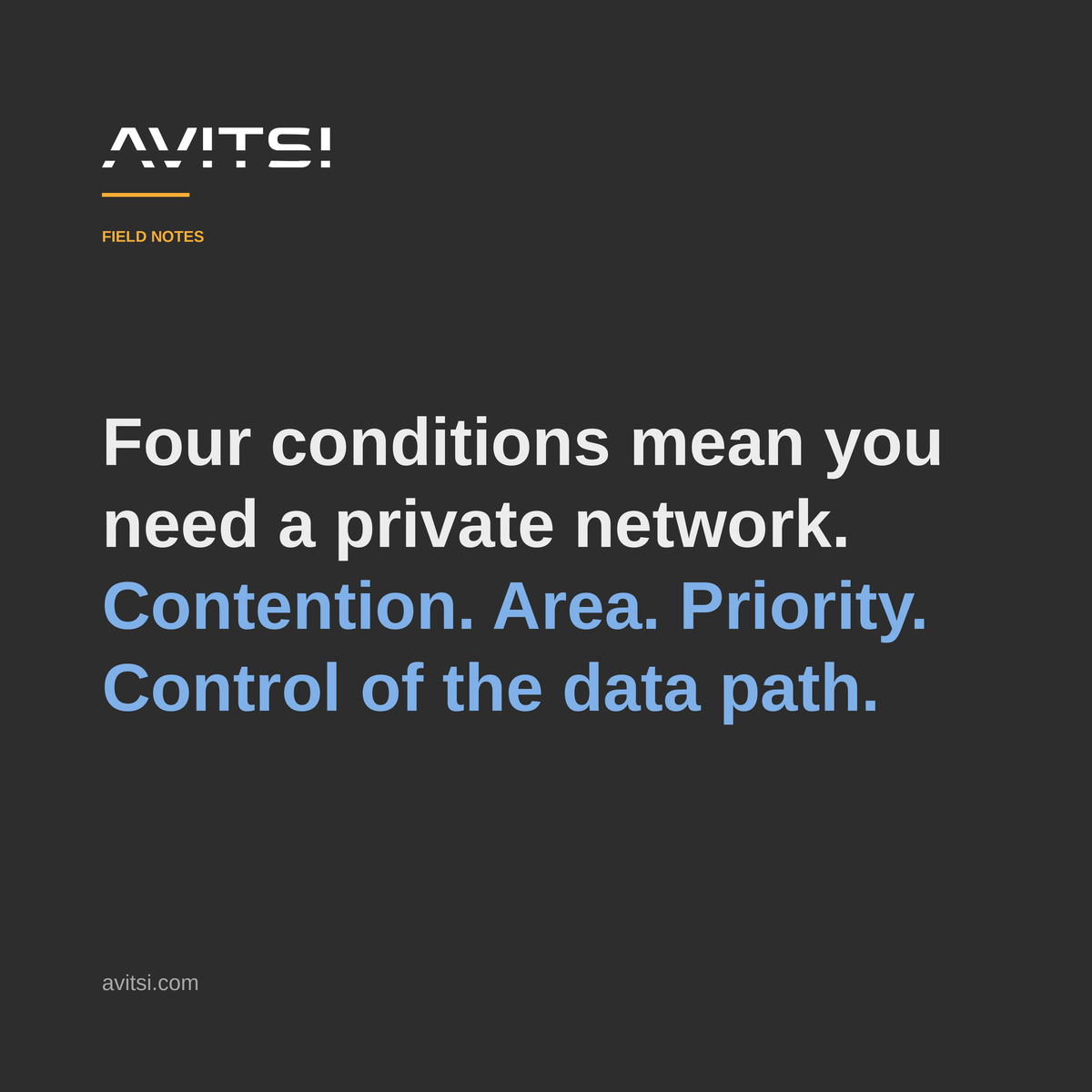
Four conditions. One of them alone is usually enough.
Contention. The venue fills, and your traffic is negotiating for the same air as every phone in the building with no leverage. This is the one that cannot be fixed by adding modems, because more paths across congested networks is still congested.
Area. Coverage across ground nobody can wire, at speed. At DirtFish that means in-car and static cameras across more than 300 acres, live 1080p60, from a single flying radio. There is no venue infrastructure to lean on — the network is the infrastructure.
Priority. The ability to say this stream matters more than that one, and have the network obey. This isn’t available unless you own the network in use. It is the value most often mistaken for speed, and it is the subject of a separate piece: Private 5G vs bonding: what you are actually choosing.
Control of the data path. Your SIMs, your core, your spectrum plan — encrypted, with SIM and eSIM authentication and a sub-15ms round trip. No one else’s traffic is on it, because nobody else has a SIM for it. For some clients that is a performance requirement. For others it is a compliance one.
The mistake that keeps happening
Buyers specify bandwidth, and get sold bandwidth, when the problem was priority.
Bandwidth is easy to quote and easy to compare, so that’s what procurement asks for. But a link with plenty of headroom at 9am and none at 3pm has not run out of bandwidth. It has run out of capacity. Nothing you can add to a public connection gives you priority on it, because capacity and priority are properties that the network owner controls.
Temporary is not the lesser case
There is an assumption that a private network is a capital project — something a campus or a plant commits to. That was true when the install took four days.
It is not true now. A nomadic build goes live in under 10 minutes out of a rolling road case, runs through the job, and comes back out. Which means the honest answer to “do we need one” can be “yes, for eleven days in March” — and that is a perfectly sensible solution for a project.
How to get to the answer quickly
Bring the first two questions, and be specific about the second one.
If what leaves the site is modest and the consequence of losing it is an apology, we will tell you so. If a client is watching, we will want to talk about the last two conditions above. That conversation usually settles it in one call.